Senet outlasted almost everything else in the history of games. It was played in Egypt for three thousand years. Boards were buried with kings. Nefertari is painted playing it alone on the wall of her tomb. Then Christianity arrived, the game stopped, and the rules went with it.
Most pages that teach "the rules of Senet" do not tell you that. This one starts with it, because the difference between what survives and what is reconstructed is the most interesting thing about the game — and because you should know which is which before you argue about a move.
What is fact
- The board. Three rows of ten squares. Hundreds survive.
- The last five squares are marked, with hieroglyphs rather than decoration: happiness, water, and the numbers three, two and one. The meaning of the marks is agreed.
- The pieces and the sticks. Sets of counters in two shapes, and throwing sticks, are found with the boards.
What is reconstruction
Everything else — how the pieces move, what a throw is worth, what happens when you land on an enemy, and how the last five squares work. Egyptologists worked it out from tomb paintings and the board's own markings, and the two most-used reconstructions, Peter Piccione's and Timothy Kendall's, disagree about the number of pieces: five each or seven each. Neither is more authentic than the other. Both are modern.
Piccione also argued that the run home is the soul's passage through the underworld — the House of Happiness, the drowning, and the final approach — which would make Senet the only game where the board is also a map of the afterlife. That is a reading, not a rule, and it is offered here as one.
What follows is one playable version, five pieces a side. Where the reconstructions differ it says so.
What you need
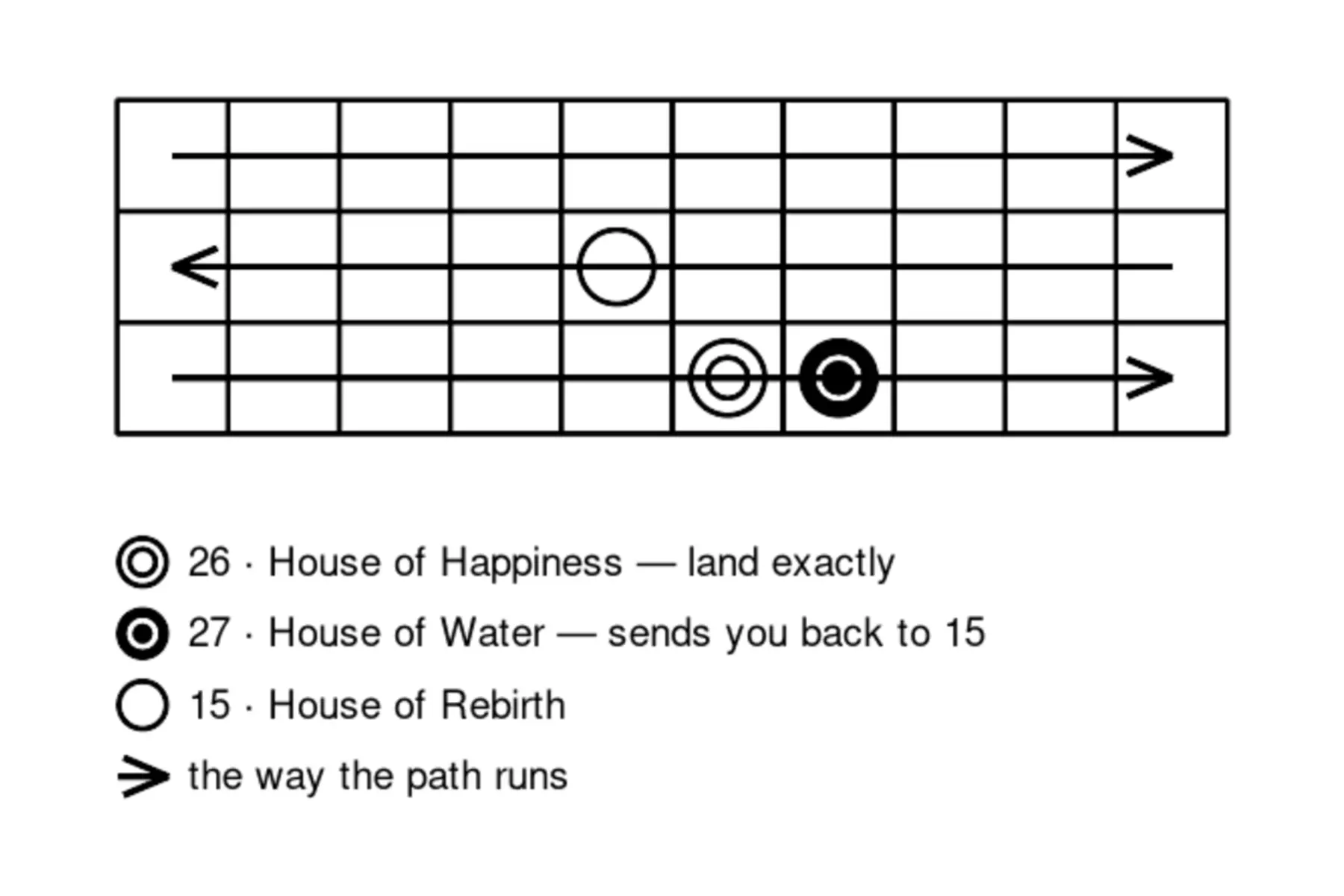
- A board of three rows of ten. Draw it: mark square 26 with a tick or a smile, square 27 with wavy lines, and squares 28, 29 and 30 with three, two and one strokes. A printable board is in the free pack at the end.
- Five light and five dark counters.
- Four throwing sticks, each with one light face and one dark. Split four lolly sticks, or use four coins.
Setup
- Number the thirty squares 1 to 30 in a snake: row one left to right, row two right to left, row three left to right again.
- Place the ten pieces alternately along squares 1 to 10 — light, dark, light, dark — so each player has five.
- The player owning the piece on square 10 moves first.
(Kendall's version uses seven pieces each on a longer opening row. The special squares behave the same.)
The throw
Throw the four sticks and count the flat (light) faces up:
| Light faces | Move |
|---|---|
| 1 | Move 1, and throw again |
| 2 | Move 2 |
| 3 | Move 3 |
| 4 | Move 4, and throw again |
| 0 | Move 5, and throw again |
You must use the throw if any legal move exists.
Movement
- Pieces travel forward along the numbered snake, never backwards — except where a rule sends them.
- Land on an enemy piece and you swap places with it. Nothing is captured; nothing leaves the board.
- Two of the same colour side by side protect each other: an enemy may not land on either or swap with them.
- Three of the same colour side by side form a blockade: enemy pieces may not pass them and must wait behind.
- Pieces on squares 28, 29 and 30 no longer protect one another.
The last five squares
This is the part of the game that is actually Egyptian, in the sense that the board itself insists on it.
- Square 26, the House of Happiness. Every piece must stop here exactly before going on. It is safe; no swap can happen on it.
- Square 27, the House of Water. A piece landing here has drowned and goes back to square 15, the House of Rebirth.
- Squares 28, 29 and 30 need exact throws of three, two and one to bear off from. A piece on square 30 leaves on a throw of one.
The first player to bear off all five pieces wins.
The rulings every table argues about
- Nobody can move. If no legal move exists for your throw, the turn passes. A blockade can hold you for several turns, and that is intended.
- Illegal move. Passing square 26 without stopping on it exactly is illegal. So is landing on a protected pair, or passing a blockade of three. Take the move back and play another.
- Draw. Not normally possible. If both players somehow cannot move for three rounds together, call it a draw — that is an editorial ruling; no source gives one.
Why the endgame is worth the trouble
The House of Water is what makes Senet a game rather than a race. Everything must funnel through square 26 and then step over 27, so a piece one square from home can still be sent back to the middle of the board by one bad throw — and the sticks give a five more often than beginners expect.
First game
Play once ignoring the last five squares entirely — just race to bear off. Then add squares 26 and 27 and play again. The difference is the whole game.
For younger children, drop the House of Water. It removes most of the tension and most of the shouting.
Frequently asked
Is there a "correct" set of Senet rules? No. The board and its marked squares survive; the rules do not. Piccione and Kendall are the two reconstructions most people play from, and they differ. Any page that presents one set as the rules is presenting a modern reconstruction as an ancient fact.
Why swap instead of capture? Because that is what the reconstruction proposes, and it produces a game that flows. It is not a fact recovered from a papyrus.
How long does it take? Twenty to forty minutes. Simple to play, genuinely tense at the end.
What age? Eight and up; six and up without the House of Water.
The Great Book of World Games prints Senet across two facing pages, with the snake path numbered and the last five squares drawn, and labels every reconstructed rule as reconstructed. It sits with the other race games — the Royal Game of Ur, Patolli, Pachisi, Yut Nori, the Game of the Goose — so you can see how six cultures solved the same problem six ways.
The board is free. A printable Senet board at full playing size is in the boards pack at valicepress.com/companion/world-games, with 30 other boards, reference cards and score sheets. No email, no account.
Related: The Royal Game of Ur: how to play a 4,600-year-old game · Seven things everyone says about old board games that are not true