About the book
A reference book you play from.
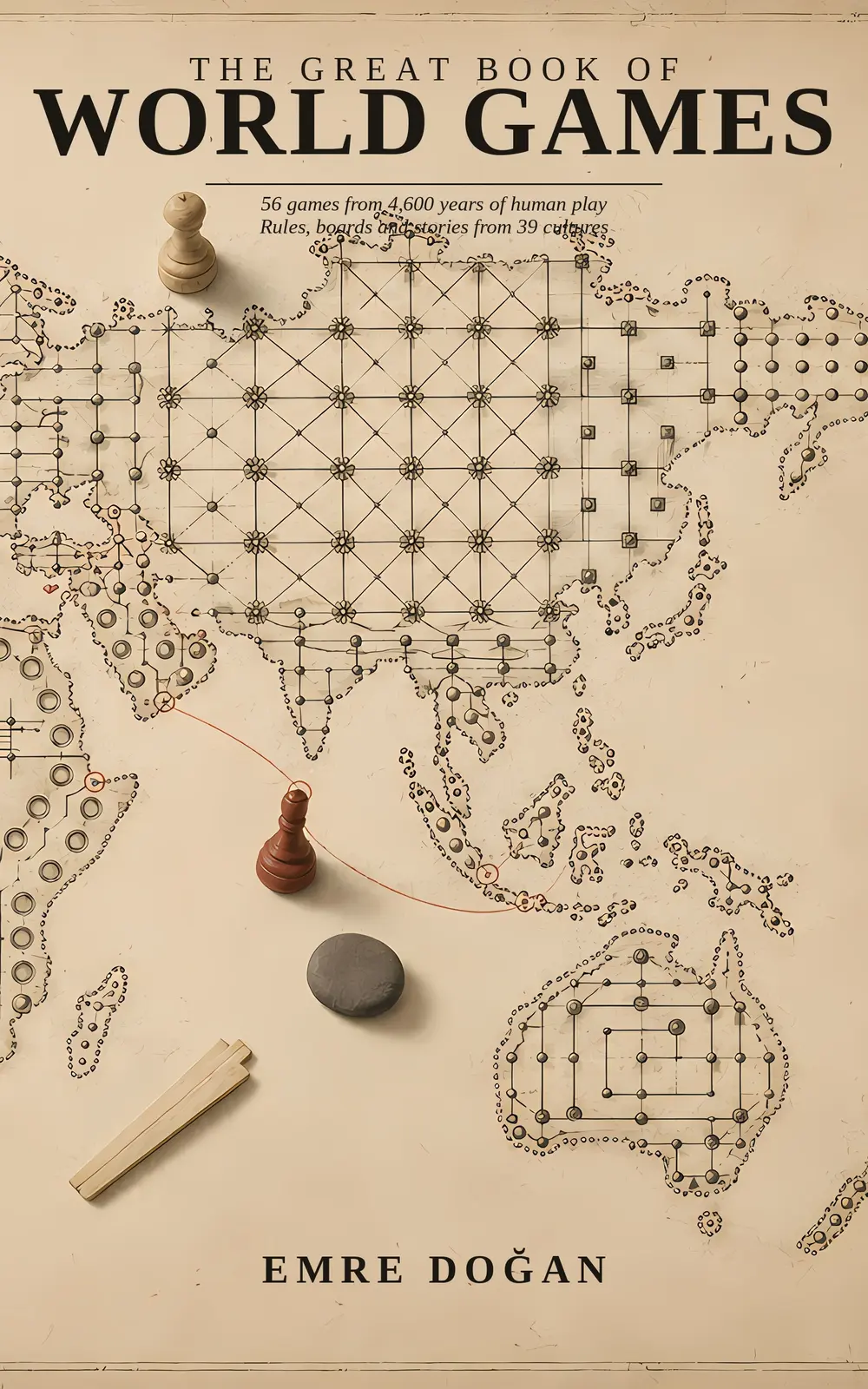
The Great Book of World Games sets out sixty-three traditional games from forty-two cultures, from the royal graves of Ur to a Zulu playground, so that you can play them tonight. Every entry gives a quick-play box (players, time, age, difficulty, what you need and the goal); where the game comes from, and how we know; what to use instead of what — buttons, coins, dried beans, an egg box; numbered rules, one action to a line, with a board diagram drawn from the rules; the disputes every table has — a draw, a blocked player, an illegal move — settled; a worked turn, played out from a stated position; a simpler first game, and variants; and the sources: the work and the pages the rules were read from.
The games are sorted by how they work, not by where they are from: seven families — the sowing games, the hunt and the siege, the race home, the line and the territory, the war board, chance and scoring, and games without a board. Put that way, the mancala games of Ghana, Sri Lanka and Buganda sit together, and six cultures solve the problem of chess six different ways.
Where a game's record is incomplete — senet, the Royal Game of Ur, the Roman game of twelve lines — the entry says what the sources give and what has been reconstructed, and whose reconstruction it follows. Where no source settles a question, the book makes a ruling and marks it as its own, so you can overrule it. A section at the back lists game origin stories that are widely repeated and are not true.
At the back: full-size boards for twenty-two of the games, drawn at playing size for the photocopier (print editions); a list of what to gather for a games kit; a glossary, the sources by work, an index of every game under every name it goes by, and indexes by culture, age and difficulty. A free companion pack online adds printable boards for the other games, a card for every game and score sheets.