About the book
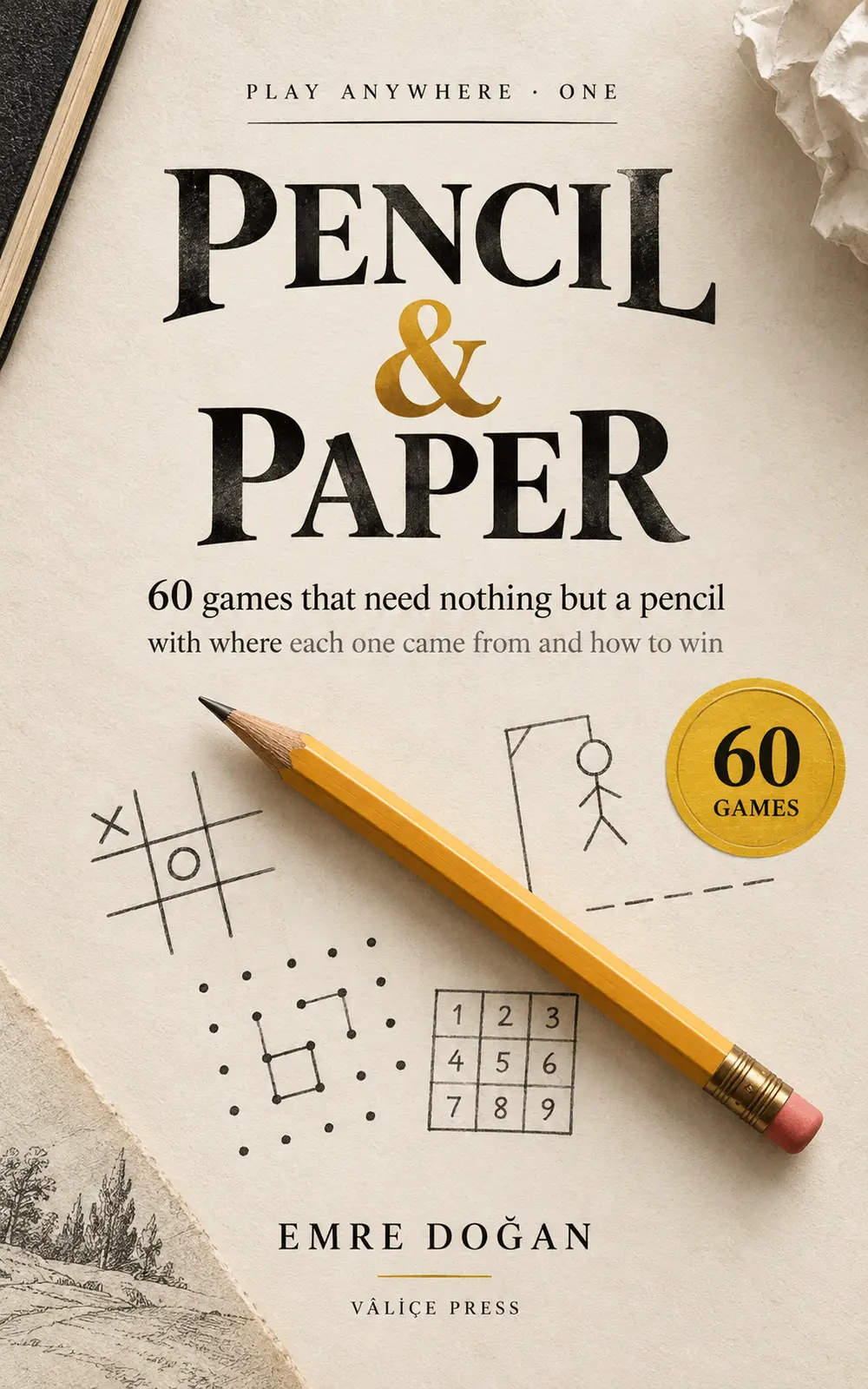
Sixty games you can play with a pencil and whatever paper is nearest. Every game gets one opening: complete rules on the left, a diagram and two notes on the right. WHERE IT COMES FROM is the part the grid pads leave out and the part that took the longest — each claim is attached to a source, and six of them were read in the original: Dots and Boxes from Édouard Lucas's own text of 1883, where he says plainly that his students at the École Polytechnique devised it and not him; Hangman's ancestor from Alice Gomme's collection of 1894; Doublets from Lewis Carroll's own letter of 1879; Kayles from Dudeney's first edition of 1907; the hundred game and the magic square from Bachet in 1612. Where a game's origin is genuinely unrecorded, eight of them, the note says so and stops. HOW TO WIN is a real strategy note, and for the thirteen solved games it gives the solution, because a solved game is not a spoiled game — it is a game with a secret. Six parts, two indexes that sort every game by how many people you have and how long you have, and eight score sheets you may photocopy.