The Royal Game of Ur is the oldest board game anyone can sit down and play tonight with some confidence that they are playing roughly what was played. That confidence has a specific source, and it is worth naming before the rules, because most pages that teach the game skip it.
The boards are archaeological fact. They came out of the royal graves at Ur, in southern Mesopotamia, in the 1920s — inlaid, beautiful, and silent. For the next sixty years nobody could play them.
The rules are a reading. What unlocked the game was not an excavation but a text: a Babylonian scribe, writing many centuries after the graves were closed, set the rules down in cuneiform, and Irving Finkel of the British Museum read the tablet. The tablet is terse. The route, the values of the dice and the exact finish are a scholar's reading of it rather than a sentence-by-sentence translation. The tablet also records betting and astrological meanings for the pieces, which are not rules and are not printed here.
So: the board is 4,600 years old. The rulebook is modern, and it is the best one there is. Everything below is that reading, labelled as such.
The board
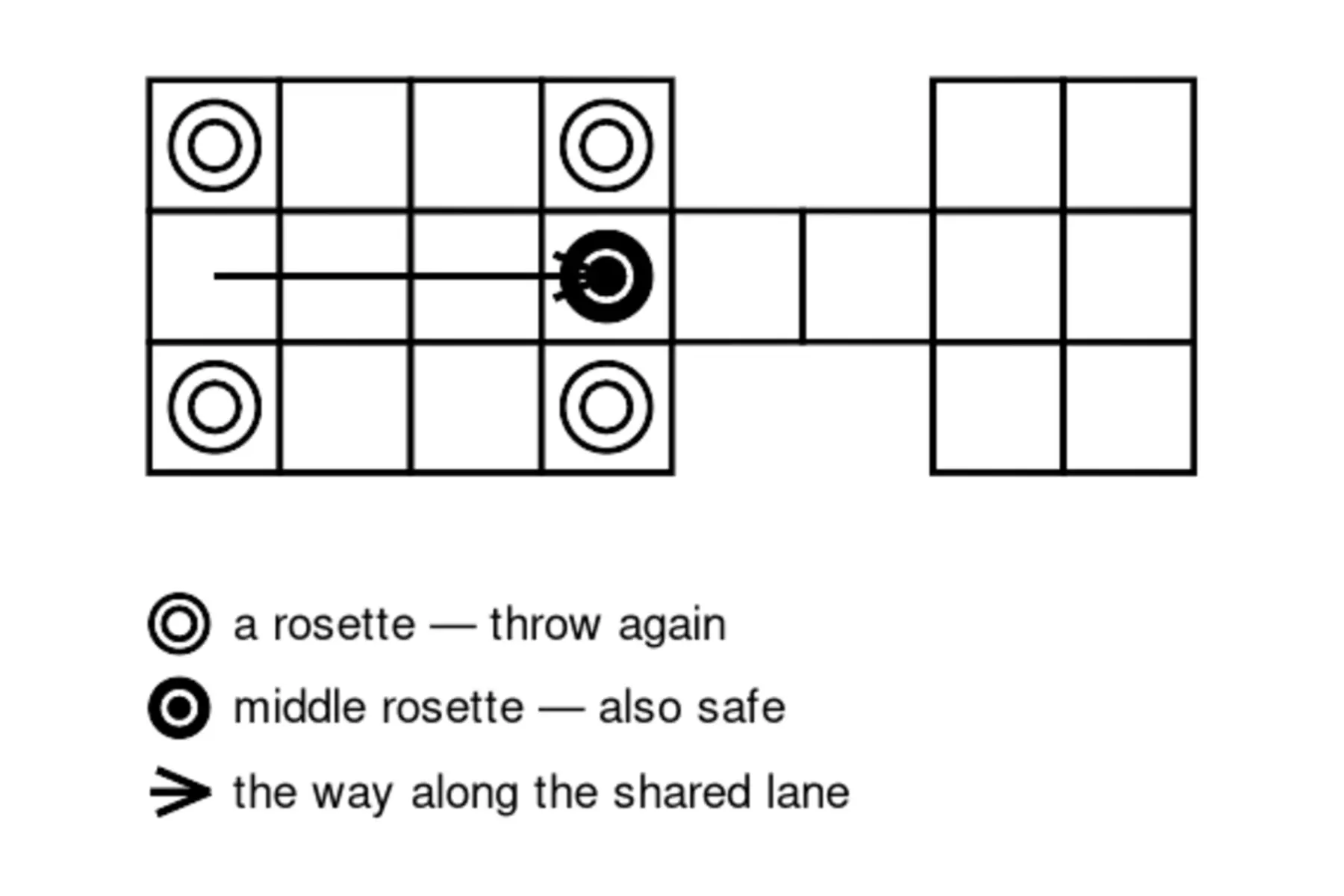
Twenty squares in three sections: a block of twelve (three rows of four), a bridge of two, and a block of six (three rows of two). Five squares carry a rosette — one in each corner of the big block's outer rows, one in each of the small block's outer rows, and one in the middle of the shared lane.
That odd shape is the whole design. Each player has a private four-square entry block and a private two-square exit, and only the eight-square middle lane is shared. Everything dangerous happens in the middle.
You can draw the board on paper in two minutes. If you would rather print it, the board at full playing size is in the free boards pack linked at the end.
What you need
- The twenty-square board, with the five rosettes marked.
- Seven counters each, in two colours. Buttons and coins are fine.
- Four two-sided dice. The historical article is four small pyramids with two of the four corners marked; four coins work exactly as well — throw them and count heads.
Setup
- Draw or lay out the twenty squares in their three sections, and mark the five rosettes.
- Each player takes seven pieces and keeps them off the board to start.
- Sit on either side. The four-square block nearest you is your entry; the two-square block nearest you is your exit.
- Highest throw starts.
The throw
Throw all four dice and count the marked corners (or heads):
| Marked corners | Move |
|---|---|
| 0 | No move. The turn passes. |
| 1 | Move one piece 1 square. |
| 2 | Move one piece 2 squares. |
| 3 | Move one piece 3 squares. |
| 4 | Move one piece 4 squares, and throw again. |
Each throw moves a single piece. If any legal move exists you must take one.
Movement
Your route has three parts: your own four-square entry block, then the shared eight-square middle lane, then your own two-square exit. A piece enters on your entry block, counting from just outside the board.
- Only one piece may stand on a square at a time.
- You may not land on a square already holding one of your own pieces. Move a different piece, or lose the turn if nothing is legal.
- Landing exactly on a rosette earns another throw.
Capture
- In the shared middle lane only, landing exactly on an enemy piece sends it off the board and back into its owner's hand. It must start its journey again from the beginning.
- The rosette in the middle of the shared lane is safe: a piece standing there can never be captured, and an enemy may not land on it.
- Your entry block and exit block cannot be reached by the enemy at all.
Bearing off, and winning
A piece leaves the board from the last square of your exit with an exact throw. With two squares to go you must throw exactly two; a three or a four cannot move that piece.
The first player to bear off all seven pieces wins. A draw is not possible.
The rulings every table argues about
These are the three questions a rules page usually leaves you to fight over. The book makes a ruling on each and says it is the book's ruling, so you can overrule it.
- Nobody can move. If no legal move exists for the number thrown, the turn simply passes. Play cannot lock, because a throw of zero already passes and pieces in hand can almost always enter.
- Illegal move. Landing on your own piece, or on the central rosette while an enemy holds it, is illegal and is taken back. So is bearing off on a throw that is not exact.
- Draw. Not possible. Somebody bears off seventh first.
The one piece of strategy worth knowing
The central rosette decides most games. It gives a free throw and it cannot be attacked, so a piece parked there is both safe and profitable — and it blocks the one square everything else has to pass. Take it early, and the middle lane becomes a toll gate.
First game
Play with three pieces each rather than seven. It takes ten minutes, teaches the rosettes and the exact bear-off, and loses nothing but length.
What is not in these rules, and why
The tablet was recorded alongside betting, and the pieces carried astrological associations. Neither is printed as a rule; the game stands on its own. And some reconstructions play a shorter route with fewer pieces — the seven-piece, three-stage route above is the one the tablet supports.
Frequently asked
Is this how the Sumerians actually played? Nobody can say. The graves at Ur are from about 2600 BC; the tablet that gives the rules is Babylonian and much later. What we have is the oldest surviving rulebook for the oldest surviving board, and the honest position is to play it and say so.
Do I need the pyramid dice? No. Four coins give exactly the same spread of results: count heads.
How long does a game take? Twenty to thirty minutes with seven pieces. Ten with three.
What age? Eight and up. The rules are simple; the tension is not.
The Great Book of World Games prints the Royal Game of Ur across two facing pages, with the board drawn to its real shape, alongside 55 other games from 39 cultures — each with its source named, its reconstruction (where there is one) labelled, and a shorter first game. It is filed with the other race games: Senet, Patolli, Pachisi, Hounds and Jackals' cousins, and the Game of the Goose.
The board is free. A full-size printable Ur board, one to a Letter sheet, is in the boards pack at valicepress.com/companion/world-games — with 30 other boards, cut-out reference cards and score sheets. Nothing to sign up for, no email asked.
Related: Senet: nobody knows how it was played. Here is one honest way to play it anyway. · Seven things everyone says about old board games that are not true