Ask for "mancala" in a toy shop and you will be handed a board with two rows of six pits and two long stores, and a rulebook that tells you to drop seeds one at a time and capture when your last seed lands in an empty pit on your side. That game is Kalah. It was designed and marketed in the United States in the 1940s. It is a perfectly good game, and it is not ancient, not African, and not what most of the world means by the word.
Mancala is a family name — the Arabic word for the whole class of games in which you lift the contents of one pit and sow them one by one into the pits that follow. There are hundreds of members. The rules printed here in outline are for five of them, chosen because they are well recorded, because they are genuinely different from one another, and because between them they cover the family's range from an evening's first game to something people spend a lifetime on.
The five, in one table
| Game | Where | Board | Seeds | Time | Age | The rule that defines it |
|---|---|---|---|---|---|---|
| Oware | Akan — Ghana, Côte d'Ivoire | 2 × 6, two stores | 48 | 20–40 min | 7+ | Capture on 2 or 3, then look back along the row; you may never starve your opponent |
| Olinda Keliya | Sinhalese — Sri Lanka | 2 × 7, two stores | 56 | 20–40 min | 8+ | Sow, and if the hollow after your last seed is empty, take the one beyond it |
| Pallanguzhi | Tamil — Tamil Nadu, Sri Lanka | 2 × 7, two stores | 84 | 30–60 min | 8+ | Relay sowing across the board; a hole that reaches four seeds pays its owner at once |
| Omweso | Ganda — Uganda | 4 × 8 | 64 | 20–40 min | 10+ | Each player circles only their own sixteen holes; captured seeds are sown onward, never banked; reverse capture |
| Bao la Kiswahili | Swahili — Zanzibar, Tanzania, Kenya | 4 × 8 | 64 | 30–60 min | 10+ | Relay sowing, compulsory capture, and the nyumba — a house pit treated differently from every other |
Two rows or four rows is the first fork in the family. In the two-row games you and your opponent sow through each other's pits and a store collects what you win. In the four-row games each player owns two rows, seeds never leave play, and the game is really two boards facing each other.
Oware — start here
The Akan game of Ghana and Côte d'Ivoire, and the rules most players mean when they say "real mancala". The version worth learning is the Ashanti one that G. T. Bennett wrote down for R. S. Rattray in the 1920s.
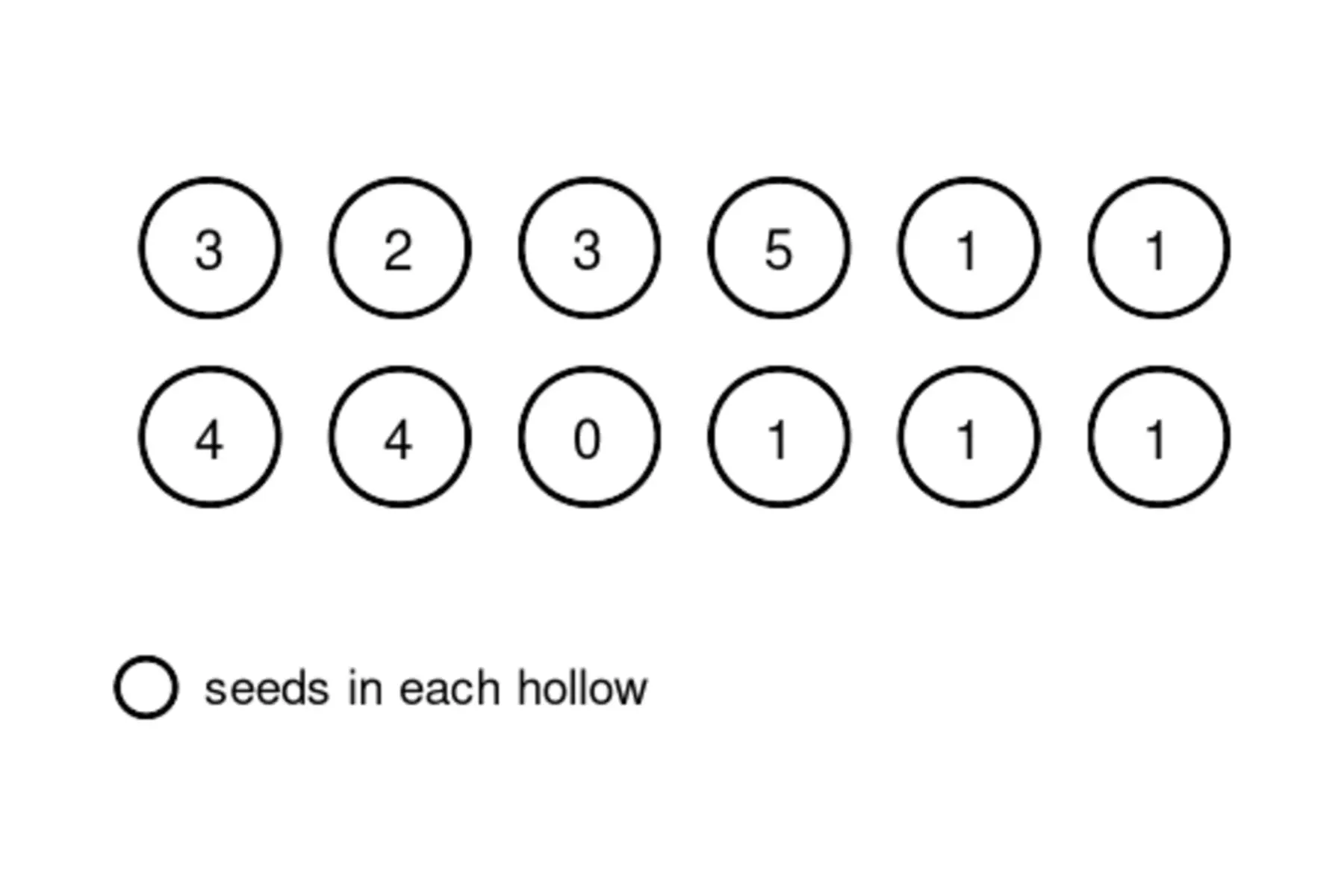
Four seeds in each of twelve holes. Lift a hole, sow anticlockwise one seed per pit. You capture only when your last seed lands on your opponent's side and makes that hole hold exactly two or three — then look back along the same row and take every unbroken two or three behind it.
Two habits of the Akan game are written into the rules rather than left to manners: you may never starve your opponent, and you may never take everything. If a capture would empty their whole side, the seeds stay where they are.
First game: play without the look-back rule — take only the hole your last seed lands in. Add the look-back once both players can see a sowing before they make it.
Easy to learn, and it does not stop being hard. Twenty minutes; seven and up.
Olinda Keliya — the same idea, a longer row
The Sinhalese game takes its name from the seed — olinda, the scarlet-and-black seeds of Abrus precatorius, which must never go near a child's mouth. H. Parker, who wrote the fullest account in 1909, recorded fourteen hollows as the invariable number in Ceylon and traced the boards backwards to rows of cup-shaped hollows cut into rock at Mihintale, which he dated no later than the fourth century AD.
Seven hollows a side, four seeds each. The capture is the simplest in the family: if the hollow after your last seed is empty, take the seeds in the one beyond it. What makes it a different game from Oware is how a turn snowballs, and a closed-hollow rule that only makes sense once you have seen a round end.
First game: play a single round rather than the full match.
Pallanguzhi — the relay
The Tamil game, recorded by R. C. Bell as a game of the women of southern India and Sri Lanka, played by men chiefly when there was money on it. The board he photographed came from Ernakulam and was chromium-plated white metal on little wheels — a household object of the mid-twentieth century, not a museum piece.
Seven holes a side, six seeds each, eighty-four in all. Two things mark it out from the games further west. Seeds do not stop when they land — a turn keeps relaying from hole to hole, and a good turn can cross the board several times. And a hole that reaches four seeds pays its owner immediately, no matter who put the fourth seed there.
First game: one round, not the full match. One round teaches the relay and the four-seed rule; the rest only matters once someone is losing.
A long game with a short rulebook. Thirty to sixty minutes.
Omweso — the royal game of Buganda
The board was kept in the royal hall and the Prime Minister played it there; a king was praised by saying he would overcome his enemies as an omweso expert defeats his opponents. Cowherds played it in the field. The standard rules are M. B. Nsimbi's 1968 booklet, which Claudia Zaslavsky reproduces.
Four rows of eight. You own the two rows nearest you — sixteen holes — and you circle only those. You capture when your last seed lands in an occupied hole of your inner row and the opponent holds seeds in both holes of that file; you take them all, and instead of banking them you sow them onward as your own, and the turn continues. Several captures can happen in one turn. Then there is reverse capture, which is what makes omweso hard.
First game: the capture rule without reverse moves. Reverse capture is easier to see once the ordinary relay feels natural.
The hardest sowing game in the book. Ten and up.
Bao la Kiswahili — the deep end
Bao is widely held to be the deepest game played on the Swahili coast, and its reputation rests on one mechanism: relay sowing. Drop your last seed into an occupied pit and you pick that pit up and keep going, and keep going, until a seed finally lands somewhere empty. A single move can travel most of the way round a thirty-two-pit board and end somewhere neither player predicted. Tournament players read these chains twenty and thirty moves deep.
Capture is compulsory. Captured seeds are not kept; they are sown straight back into your own rows. And the fourth pit from the right of your front row is the nyumba, the house, treated differently from every other pit while it holds its seeds. The opening is unusual too: only ten seeds start on the board, and the other twenty-two enter from your hand over the first phase.
First game: the learning game — all seeds on the board, no nyumba, no compulsory capture. Relay sowing alone will take a full game to get used to.
The hardest game in the book. Thirty to sixty minutes; ten and up.
The order to learn them in
- Oware. The family's grammar: sow, capture on a count, protect the opponent from ruin.
- Olinda Keliya. Same shape, different capture, and the first taste of a turn that snowballs.
- Pallanguzhi. The relay, on a board you already understand.
- Omweso. Four rows: your own circuit, nothing leaves play, captures that keep sowing.
- Bao. Everything at once.
Skip Kalah, unless it is the board you already own — in which case play Oware on it. Two rows of six and two stores is exactly the Oware board; only the rules on the box are American.
What to play with
Nobody in this family needs a purchased board. An egg carton is two rows of six. Dried beans, buttons, coins or pebbles are seeds. For the four-row games, two egg cartons side by side, or fourteen-hole boards drawn on card. The stores are saucers.
Frequently asked
Which one is "authentic"? All of them, in the sense that all five are recorded games of real communities. None of them is the original mancala — the family is older than any single member, and the earliest boards are rows of hollows cut into rock whose rules nobody wrote down.
Is Kalah a mancala game? It uses the sowing mechanism, so yes, in the family sense. It is not an African game and not an ancient one.
Can children play? Oware from about seven. Olinda Keliya and Pallanguzhi from eight. The four-row games from ten.
The Great Book of World Games prints all five across two facing pages each — the full rules, one action to a line, a board diagram drawn to scale, a shorter first game, and the three rulings every table argues about — and files them together, so that the sowing games of Ghana, Sri Lanka and Buganda sit side by side and you can see what they share and where they part. Every rule set names the work it was read from.
The boards are free. Printable boards for the sowing games, with 31 boards in all, cut-out reference cards and score sheets, are at valicepress.com/companion/world-games. No email, no account.
Related: Seven things everyone says about old board games that are not true — including why Kalah is not ancient · The Royal Game of Ur: how to play