About the book
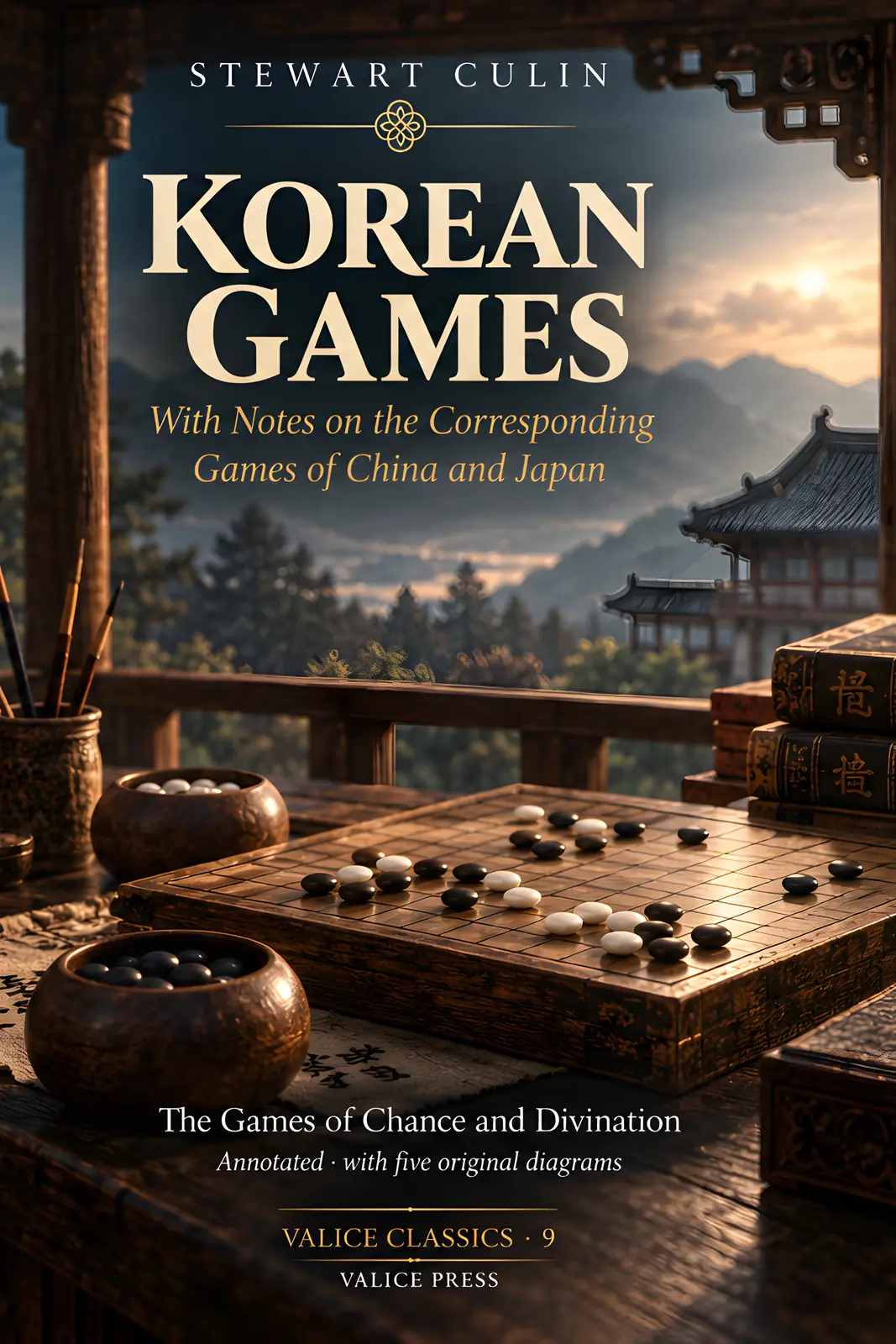
A museum catalogue is normally the least argumentative thing a scholar writes. This one is a thesis from its first sentence. “The object of this collection,” Culin begins, “is to illustrate the probable origin, significance, and development of the games of chess and playing-cards” — which, following a suggestion from Frank Hamilton Cushing, he takes to descend from the divinatory use of the arrow. Everything that follows is arranged to make that case: the chessboards first, then the quivers and divining splints and carved gambling sticks that are supposed to be arrows in disguise, then the cards, ending with a whist pack sold as a souvenir of the Chicago fair the collection was assembled for. Murray disbelieved the thesis and the field has left it alone since. But an object is not a claim: when Culin writes that sixty-two gambling sticks five inches long came in a leather pouch and were collected by Dr A. H. Hoff of the United States Army, that stays true whatever one thinks about arrows. This is a book whose evidence outlived its argument, and this edition is built to let the two be told apart. A Register of Object and Argument gives, part by part, what the objects are, what Culin says they show, what the claim actually rests on, and how to read the difference. The nine forms of chess he catalogues are compared on one table drawn entirely from his own descriptions. His introduction and entries 45 to 120 complete, in four parts — chess and the games of the board, the arrows and lots and gambling-sticks, the cards of Asia, and the tarots and the cards of Europe and America. Around them: five original diagrams marked EVIDENCE or RECONSTRUCTION, an account of how the divining procedures actually work, a playing guide, a who's-who, a glossary, a chronology, a note on tracing an object today, and an index of subjects generated from the text. 120 pages, 6 × 9 in.