Walk the mythology shelf in any general bookshop and count. Greek, Greek, Norse, Greek, Egyptian, Greek. There is nothing wrong with Greek mythology — it is superbly documented, endlessly retold, and it happens to be the tradition Western education carries. But it is one of a great many, and its dominance on the shelf is a fact about publishing rather than a fact about the world.
This is a starting point for the rest. Nineteen traditions, in the order they appear in Codex Mythologica, each with one story to begin on and a sentence about why that one.
The four you have probably met
Greek — Prometheus the Firebringer. Start here rather than with Heracles: the labours are a list, and Prometheus is an argument. A god steals fire for people and is punished forever for it, and the story has never stopped being about something.
Egyptian — The Murder of Osiris. The founding crime of the tradition, and the reason for almost everything else in it. Isis reassembling her husband is where Egyptian myth's peculiar preoccupations — order, decay, restoration — all begin.
Norse — The Binding of Fenrir. Better than Ragnarok as an opening, because it is small. The gods must chain a wolf who is growing too fast, and the only way to do it is to lie to him, and one of them must put a hand in his mouth as surety. It tells you what kind of gods these are in four pages.
Roman — Romulus and Remus. Read it as a foundation story rather than as Greek myth with different names, and it is far stranger: a city founded by a fratricide, and the Romans told it about themselves on purpose.
The five with deep literatures
Hindu — The Churning of the Ocean of Milk. Gods and demons pull a mountain back and forth on a serpent to make the sea give up its treasures. It is cosmology as an engineering problem, and it is very old.
Japanese — Amaterasu in the Cave of Heaven. The sun hides in a cave and the world goes dark; the other gods get her out with a party loud enough to make her curious. A rare myth in which the crisis is solved by mischief rather than force.
Mesopotamian — Gilgamesh and the Quest for Immortality. The oldest long story we have. A king refuses to accept that his friend is dead, and the answer he gets is not the one he went for.
Celtic — The Children of Lir. Four children turned into swans for nine hundred years. Irish myth is unusually willing to let sorrow simply last, and this is the clearest case.
Persian — the tradition where good and evil are genuinely symmetrical opponents rather than a strong god and a rebel, which changes the shape of every story in it.
The ten the shelf usually skips
Aztec — The Five Suns. Four worlds have already been made and destroyed; ours is the fifth and it is also temporary. Almost no other tradition is this direct about the universe being on a clock.
Mayan — a separate literature from the Aztec one, with the Popol Vuh at its centre, and routinely confused with it by people who should know better.
Korean — founding myths with bears and tigers in them, and a strand of storytelling that runs straight into modern Korean film.
Slavic — reconstructed from later sources and folk survival rather than from a scripture, which makes it harder to write about honestly and more interesting when someone does.
West & Central African — the trickster traditions, among others; the ancestor of a great deal of storytelling in the Americas by a route nobody chose.
Polynesian — navigation, islands fished out of the sea, and Māui, who is the best trickster in world myth and is not widely read outside the Pacific.
Inuit — Sedna at the bottom of the sea, and a body of story shaped by an environment that forgives nothing.
Turkic & Tengri — the sky-god traditions of the steppe, poorly served in English and closer to the centre of Eurasian history than the shelf suggests.
Arabian — pre-Islamic and later material, of which most English readers know one frame story and none of the rest.
How to actually read them
Two suggestions, both learned the hard way.
Read a whole tradition before comparing traditions. Comparative mythology is a real and useful field, and it is also the fastest way to flatten nineteen literatures into a diagram of archetypes. Read seven Norse stories in a row and Norse myth starts to have a temperament. Read one from each of nineteen and you get a taxonomy.
Check who is retelling. A myth reaches English through a chain — an oral teller, an ethnographer, a translator, a reteller — and every link chooses. A retelling that will not name its sources is not necessarily wrong, but it has decided you should not be able to check.
The book
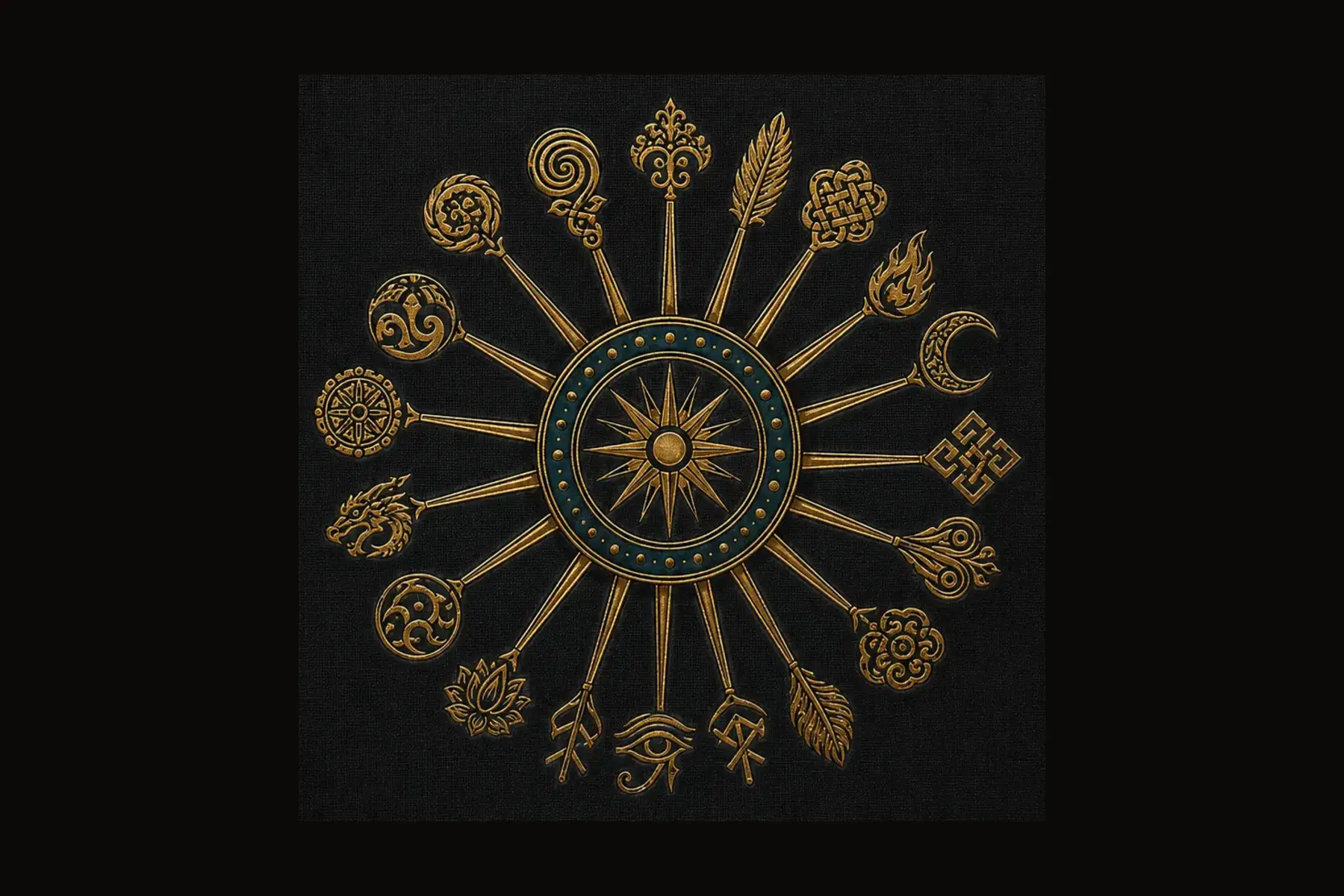
Codex Mythologica collects 76 myths from these 19 traditions, each retold at full length rather than summarised — the difference between a story and an entry in an encyclopaedia of stories. 329 pages in paperback, hardcover and a large-print edition.
For younger readers, The Great Book of World Myths does the same job for ages 8–12: 45 myths from 22 cultures, built deliberately against the eighty-per-cent-Greek shelf — no culture gets more than four stories and Greece gets no more than three. It has a hand-drawn world map, per-culture cards and a sourced pronunciation guide, and it says plainly which material it excludes and why.