
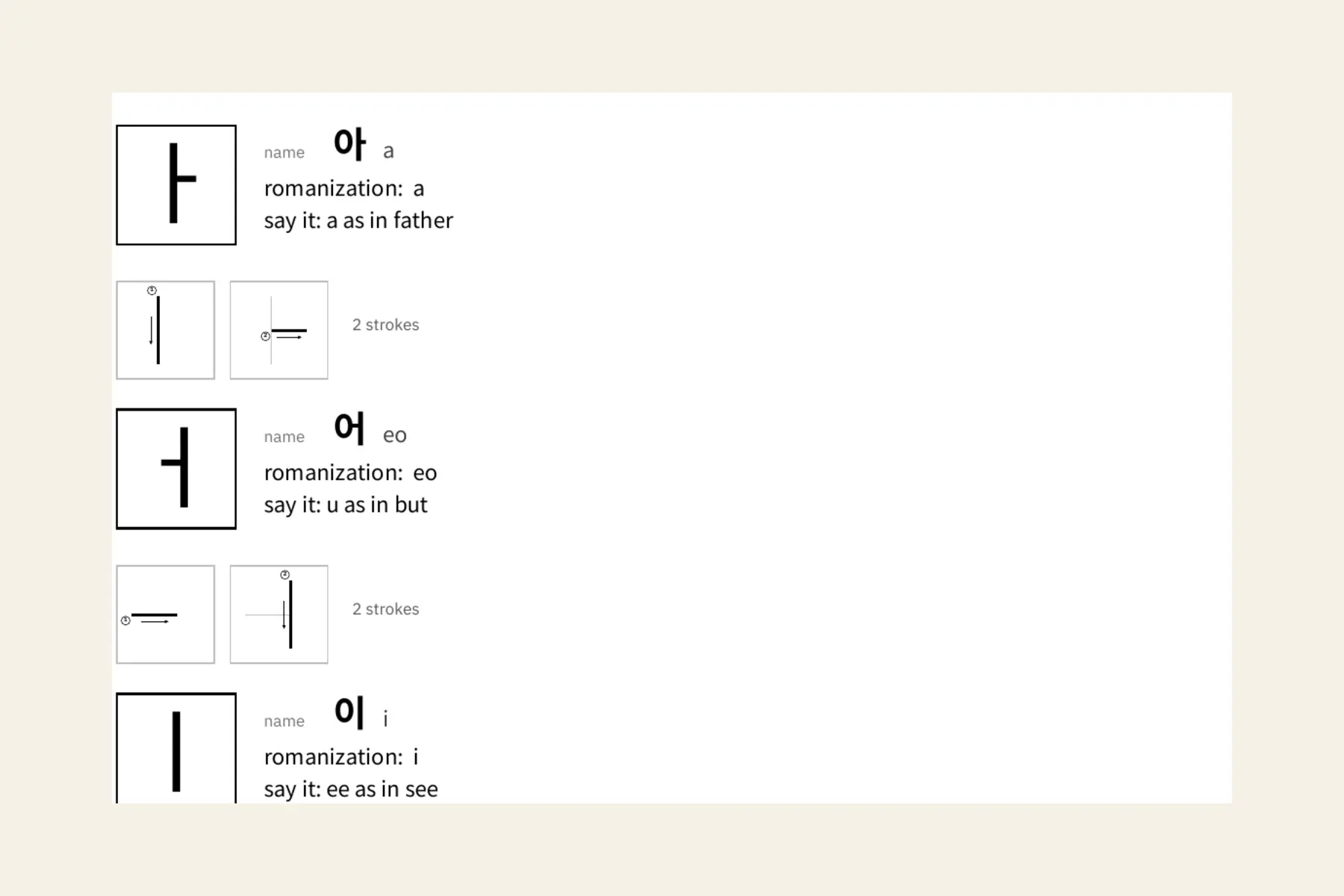
Most guides to Hangul start with the sounds. That is the wrong end for a lot of people. If you are going to learn Korean by hand — and writing a letter is still the fastest way to stop confusing ㅂ with ㅁ — then stroke order is the first thing that matters, and almost nobody tells you where the orders come from.
The rule that covers most of it
Hangul stroke order follows the same two principles as Chinese and Japanese, for the same reason: the brush moved that way.
- Top to bottom.
- Left to right.
Applied in that order of priority. In ㄱ, the horizontal comes first because it is on top; in ㅏ, the long vertical comes first because it is on the left. Nearly every letter falls out of those two rules, and if you are ever stuck mid-letter, guessing "the stroke that starts highest, and if two start equally high, the one further left" will be right far more often than not.
The part the rule does not cover
Two things break it.
Compound consonants. ㄲ, ㄸ, ㅃ, ㅆ, ㅉ are written as two complete copies of the base letter, left one first, and each copy internally follows the normal rule. You are not writing one wide letter; you are writing the letter twice.
ㅊ and ㅎ. Both begin with a short stroke above the rest of the letter. It is written first — top to bottom holds — but it is easy to treat it as an accent added at the end, the way an English writer crosses a t last. It is not an accent. It is stroke one.
Vowels tell you where they go
This is the part that turns letters into words, and it is a shape rule, not a memory task.
- A vowel built on a long vertical line — ㅏ ㅑ ㅓ ㅕ ㅣ — stands to the right of its consonant.
- A vowel built on a long horizontal line — ㅗ ㅛ ㅜ ㅠ ㅡ — sits underneath it.
You can predict the layout of a syllable block you have never seen from the shape of its vowel alone. That is unusual in a writing system and it is worth knowing on day one rather than day thirty.
Where these orders actually come from — and where they are contested
Here is the part most guides skip, and the reason we can be specific.
When we built the Korean Hangul Handwriting Workbook, we recorded the provenance of every stroke sequence in it. Of the 40 letters:
- 28 stroke sequences were transcribed from published diagrams — that is, someone with authority had already set them down, and we followed.
- 12 were derived from the rule — no published diagram was found for that exact letter, so the sequence follows from top-to-bottom-then-left-to-right and is marked as derived rather than attested.
That distinction is printed in the book, on a provenance page, because it is the honest state of the evidence. Anyone who tells you all forty orders are settled and documented has not gone looking. Anyone who tells you it does not matter has not tried to read someone else's handwriting.
One thing that is not a stroke-order question
ㄱ is not English g, and it is not English k. It is one single Korean sound sitting between them — softer than the k in kite, harder than the g in go. Same for ㄷ, between d and t. The official romanization sometimes writes k and t; that is a spelling rule about position, not a second sound.
Beginners who learn ㄱ as "g" and then meet it romanized as "k" usually conclude they have misunderstood something. They have not. There is one sound and two spellings of it.
The workbook
The Korean Hangul Handwriting Workbook is 124 pages built for exactly this: 30 lessons covering all 40 letters plus 16 single batchim, through 122 numbered stroke-order diagrams, moving trace → dot-start → empty box. Then syllable-block mechanics, then 97 practice words — every one checked against the National Institute of Korean Language's learner vocabulary list, with the source stated.
It is a workbook, so it is 8.5 × 11 and it lies flat.
Free practice sheets are at valicepress.com/companion/hangul — printable, unlimited, no email required.