In The Canterbury Puzzles, Henry Dudeney gives the problem to a haberdasher on the road to Canterbury, and admits in the same breath that the man is bluffing:
Many attempts were made to induce the Haberdasher, who was of the party, to propound a puzzle of some kind, but for a long time without success… As a matter of fact, he was really playing off a practical joke on the company, for he was quite ignorant of any answer to the puzzle that he set them.
He produces a piece of cloth cut as a perfect equilateral triangle and asks:
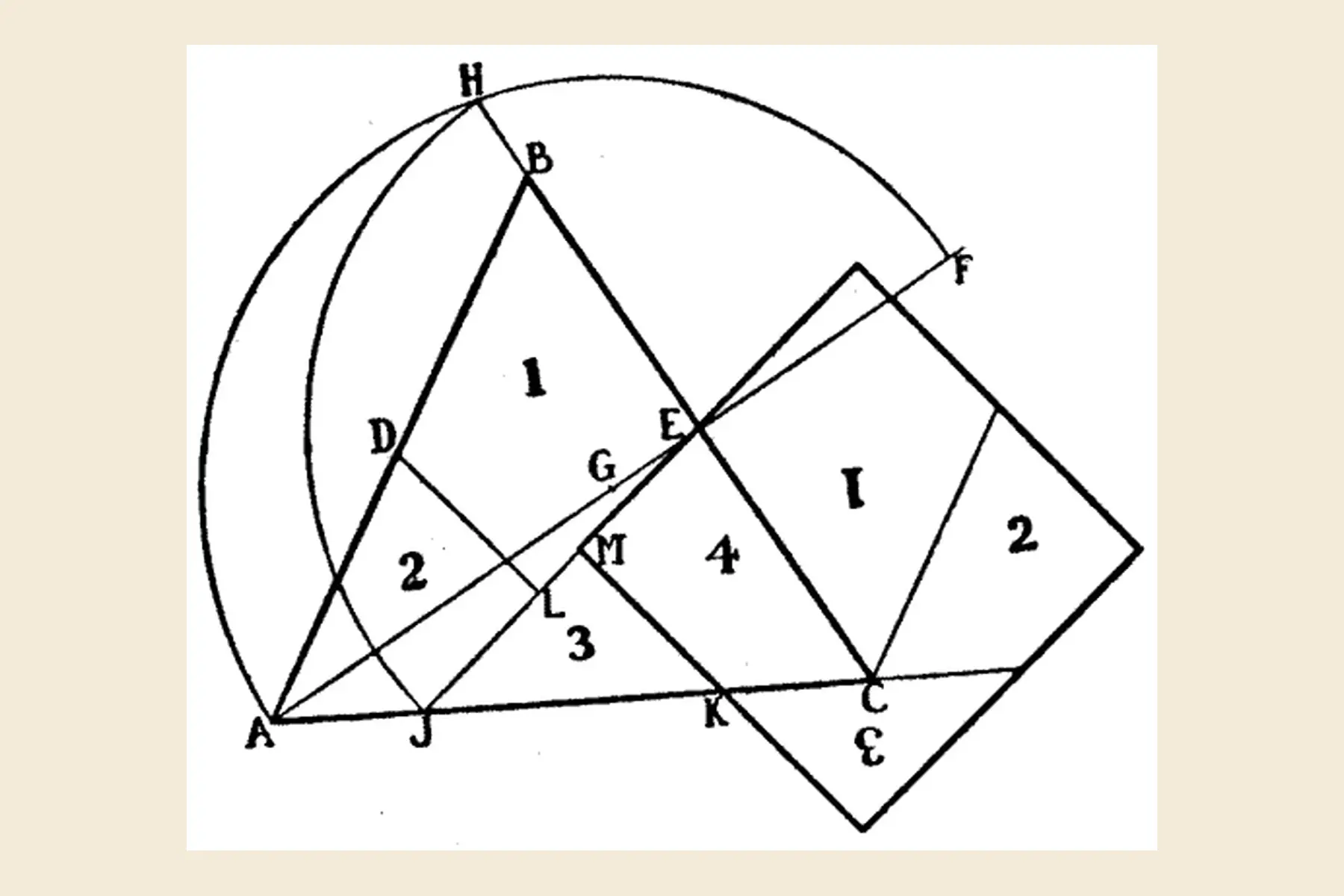
Show me, then, if ye can, in what manner this piece of cloth may be cut into four several pieces that may be put together to make a perfect square.
Four pieces. Not five, not six. An equilateral triangle into a square.
The construction, in Dudeney's words
This is his own solution text, unaltered:
Bisect AB in D and BC in E; produce the line AE to F making EF equal to EB; bisect AF in G and describe the arc AHF; produce EB to H, and EH is the length of the side of the required square; from E with distance EH, describe the arc HJ, and make JK equal to BE; now, from the points D and K drop perpendiculars on EJ at L and M.
Read it with a compass and a straightedge in hand rather than off a screen — it is a set of instructions, not a paragraph, and it goes quickly once you are drawing.
The step doing the real work is EH. The arc through A and F is a semicircle on AF, so EH is the geometric mean of AE and EF — which is exactly the side of a square with the triangle's area. Everything after that is placing the cuts.
What makes it famous
Two things, and only one of them is the mathematics.
It hinges. The four pieces can be joined at three points and swung open: a chain that folds one way into a triangle and the other way into a square. Dudeney had a model made in polished mahogany with brass hinges and showed it to the Royal Society at Burlington House on 17 May 1905, and to the Royal Institution the month after. A dissection you can hold is a different object from a dissection you can prove.
He set it as a challenge in a newspaper. It ran in the Daily Mail first, and the answer arrived from the readership. That is how a great deal of Dudeney's best material worked — he was a puzzle columnist for thirty years, and the column was a conversation.
What is still open
The natural next question — can it be done in three? — has never been answered. There is no known three-piece dissection of an equilateral triangle to a square, and no proof that four is the minimum. It is one of those problems that looks like it should have been settled in 1910 and has not been settled yet.
For the four-peg Tower of Hanoi, Dudeney's other famous unfinished business, the answer did eventually arrive: Thierry Bousch proved the Frame–Stewart move count optimal in 2014, in La quatrième tour de Hanoï. Five pegs and above remain open. Dudeney set that one too, as the Reve's puzzle, with cheeses on stools.
The edition
The Puzzles of Henry Dudeney — Annotated is 110 puzzles chosen from the 544 in Amusements in Mathematics and The Canterbury Puzzles, in Dudeney's own words and with his own solutions and original figures.
What we added, because nobody else has: a hint for every puzzle that tells you where to look without giving the answer, a difficulty mark on every one, editor's notes on the famous ones, a glossary of pounds, shillings and pence — Dudeney's money puzzles are unreadable without it, and 62 of the 544 involve pre-decimal currency — a chronology of his life, and a concordance back to the original numbering so you can always find the puzzle in its first home.
144 pages, $9.99, as both a watermarked PDF and an EPUB. The full text of both source books is in the public domain and free on Project Gutenberg; what you are paying for here is the selection and the help.
Twelve free puzzle sheets and a hints booklet are at valicepress.com/companion/dudeney — no email, no account.